


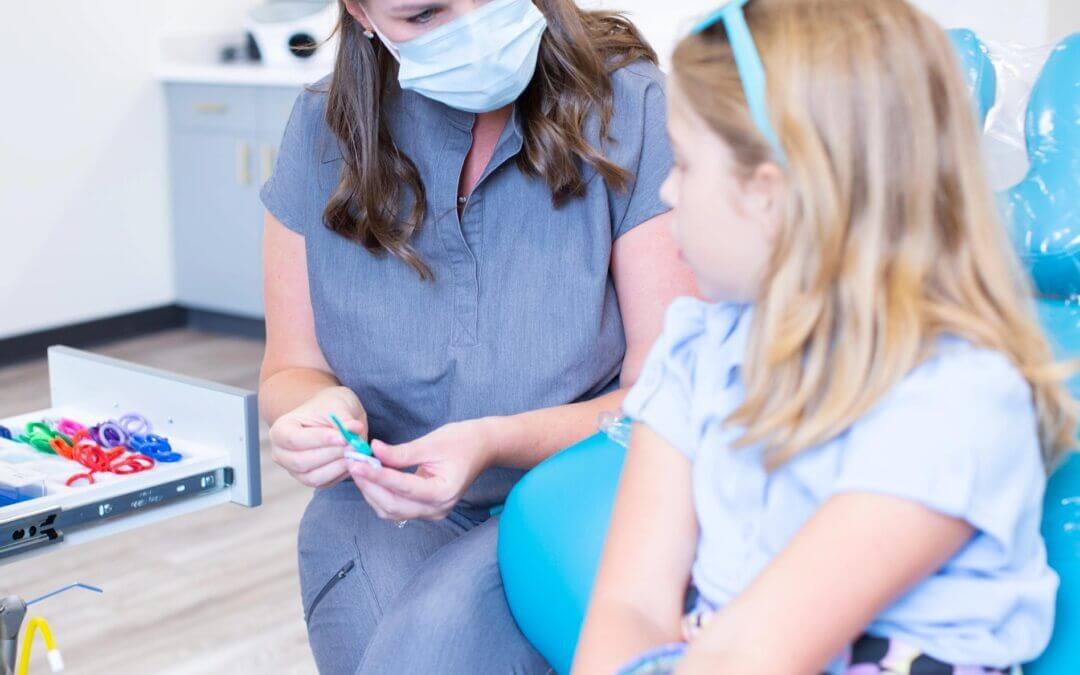
Seven is the number to remember. The American Association of Orthodontists recommends that children have their first orthodontic check-up no later than age 7, when they typically have a mix of baby and permanent teeth. That gives an orthodontist a useful window into how the teeth, bite, and jaws are developing.
If you’re wondering what age your child should see an orthodontist, an evaluation around ages 6–7 is a good starting point. It doesn’t mean your child needs braces at 7. In fact, many children simply need to be monitored until the timing is right. Our goal is to catch developing problems early enough to make a thoughtful decision about what, if anything, needs to happen next.
The quick answer for parents
Here’s what an early orthodontic evaluation really means:
- Schedule the first check-up around ages 6–7
- Don’t assume an evaluation means treatment will begin
- An earlier evaluation can identify bite, crowding, eruption, and jaw-growth concerns
- Some children benefit from Phase I treatment while others are simply monitored
- If you notice a significant bite or growth concern before age 7, you don’t have to wait
The AAO makes an important distinction between an orthodontic check-up and starting orthodontic treatment. Only certain problems require intervention around age 7.
Why age 7 gives us useful information
Around age 7, children usually have their first permanent molars and several permanent front teeth. At the same time, the jaws are still growing. That combination lets us see patterns that may be harder to evaluate when a child is younger.
During an early orthodontic evaluation, we’re looking beyond whether the front teeth appear straight. We consider how the upper and lower jaws relate, whether permanent teeth have adequate space, where teeth are erupting, and whether the bite is developing normally.
For families in Charleston, an early visit can provide useful information even when nothing looks obviously wrong at home.
Seeing an orthodontist at 7 doesn’t mean getting braces at 7
This is probably the biggest misconception about early orthodontics.
A first visit may end with a simple recommendation: wait. When there’s no reason to intervene, an orthodontist can monitor dental development and choose a more appropriate time to begin treatment if it becomes necessary. The AAO describes observation as a common outcome after an early evaluation.
At Holy City Orthodontics, not every child who comes in for an evaluation needs Phase I treatment. We’d rather identify the right timing than begin treatment simply because a child has reached a particular birthday.
Some signs are worth checking sooner
You don’t necessarily need to wait for age 7 if something about your child’s teeth, bite, or jaw development concerns you.
Our early treatment evaluations commonly look at crowding, underbites, crossbites, open bites, overbites, and habits such as thumb sucking, tongue thrusting, mouth breathing, or extended pacifier use. Some of these problems are easier to address while the jaws are still developing.
Difficulty biting properly, early loss of baby teeth, jaw clicking, and grinding are also reasons to have a child evaluated.
Wondering if what you’re seeing is normal development or something that deserves attention? A complimentary evaluation can give you a clearer answer without committing your child to treatment. Schedule your child’s free orthodontic evaluation today.
When early treatment can make sense
Phase I orthodontic treatment happens while a child still has some baby teeth. The purpose isn’t simply to straighten every tooth early. It can be used in selected cases to guide jaw development, address certain bite problems, create room for permanent teeth, or correct habits that are affecting the developing bite.
At our practice, early treatment options can include appliances such as a palatal expander or partial braces, depending on the problem. We also offer Invisalign First for appropriate younger patients.
Some children who complete Phase I still need braces or Invisalign Teen later. Early treatment addresses a specific developmental problem; it doesn’t automatically replace comprehensive treatment during adolescence.
What if my child is already older than 7?
Don’t worry about having “missed” the window. Age 7 is a recommended time for the first evaluation, not a deadline after which orthodontic treatment stops working.
The AAO notes that many patients begin treatment between ages 9 and 16 depending on development and treatment needs. If your child is 8, 10, 12, or already a teenager and has never seen an orthodontist, an evaluation can still tell you what’s happening and whether treatment is appropriate now.
For older children and teens, our options include traditional and clear braces and Invisalign Teen. The recommendation depends on the bite, tooth position, growth, and the type of correction needed.
What happens at your child’s first orthodontic visit?
The first appointment is a chance to gather information, not rush into a decision. Our initial consultation is complimentary and typically lasts about 30–60 minutes.
Dr. Anderson evaluates the smile, bite, and facial esthetics and talks with you about any concerns. Photos or x-rays may be taken when necessary, and our iTero digital scanner can create a 3D image of the teeth. If treatment is recommended, we’ll explain the options, timing, insurance information, and payment choices clearly.
If your child doesn’t need treatment yet, that’s useful information too.
Early evaluation is about timing, not rushing treatment
Orthodontics during childhood gives us something we don’t have once growth is complete: the opportunity to watch how the teeth and jaws develop.
Sometimes that leads to early intervention. Sometimes it means checking development periodically and waiting. Both can be appropriate outcomes from the same first visit.
Dr. Anderson is a board-certified orthodontist caring for children and teens at our Johns Island and downtown Charleston offices. Our approach is to explain what we see, recommend treatment when it makes sense, and help families understand the timing behind that recommendation.
Schedule your child’s first orthodontic check-up in Charleston
If your child is approaching age 7, you don’t need to wait for every permanent tooth to come in before scheduling an evaluation. And if they’re already past 7, it’s still a perfectly good time to get a baseline.
Call us at (843) 823-3533 to schedule at our Charleston-area practice. We’ll evaluate your child’s teeth, bite, and jaw development and let you know whether treatment is needed now, later, or not at all. Book your child’s free orthodontic consultation today.